At Wild Woodbury, natural restoration thrives under the guidance of Wilder Dorset Ranger, Seb Elwood. Witness the landscape’s transformation where free-roaming species signal a successful return to wildness.
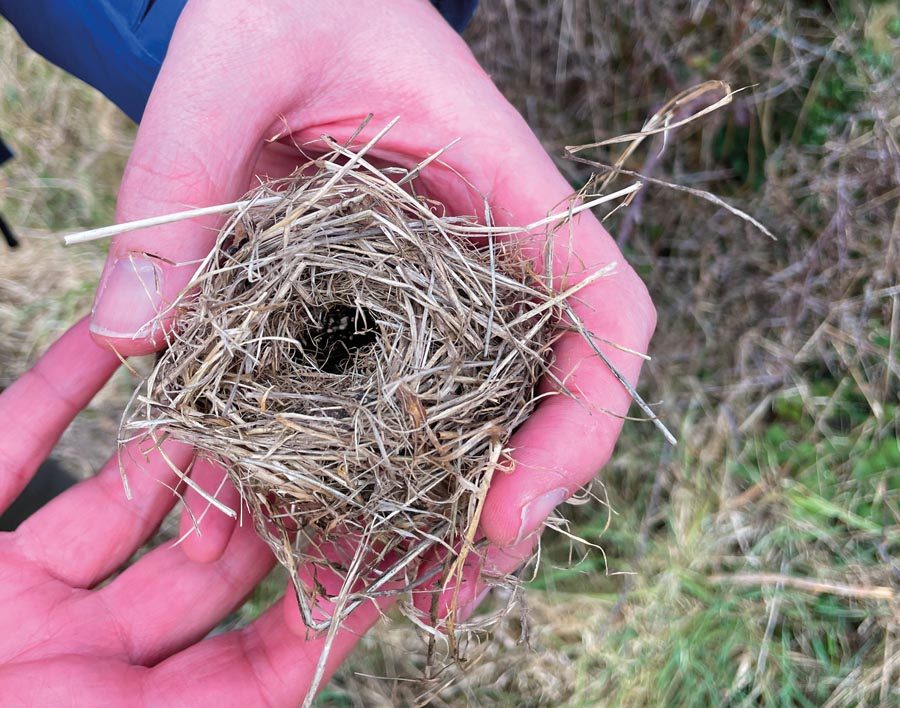
It’s swimming! Have you ever seen that before?” Someone plucks up the courage to bring me back to reality… “What is it…?” It was a harvest mouse. These amazing little mice are the only species in Britain to have a prehensile tail, which means they can use it as an extra limb to cling onto vegetation when climbing. However, this little guy is far from climbing; it’s zooming along like a remote-controlled toy boat in the newly restored River Sherford. Astonishingly, this is the third species of small mammal we’ve seen in about 30 steps.
First up, we spotted the site’s first water shrew, which, unlike the harvest mouse, was swimming fully submerged. I’ve always had a soft spot for shrews and their fantastically dexterous noses. Thanks to their saliva they are one of the few venomous mammals on the planet, although of course they are no threat to us! Next up, we spotted a field vole scampering away from us, only to be distracted by our swimming harvest mouse.
This is now a regular occurrence when walking across Wild Woodbury; I quickly lose count of the small mammals that I see scuttling away from my feet. So, what is going on? As the land has been allowed to naturally move from bare ground and cut pasture toward longer swards and scrub taking hold, the species that had been clinging on to the edges of the fields have not only spread out across the land but exploded in number after finding plentiful food and cover. The site has now recorded all three UK mainland shrews, field and bank vole, wood mice, harvest mice and dormice and if I am seeing them regularly as I’m walking about, it is safe to say the place must be bursting at the seams with them.
You won’t be surprised to know that I’m not the only one to notice this sudden boom in small mammals. Evidence abounds across the site of badgers, foxes, stoats and weasels digging up small mammal burrows to reach nests; buzzards and kestrels are now a constant; and the bounty has brought in hen harriers, short eared owls and recently, even the site’s first great grey shrike. I’ve seen grey herons happily hunting voles in the middle of old fields nowhere near the water, and back in the summer, we were pleased to find evidence of breeding adders in two locations.
It is worth contemplating that this abundance at Wild Woodbury would have once been so commonplace so as not to warrant comment. The sobering thought I am left with, is that I should be more amazed that we have lost so much from most of the landscape without noticing.