Dorset Environmental Records Centre

Newsletter No. 91 Spring 2024

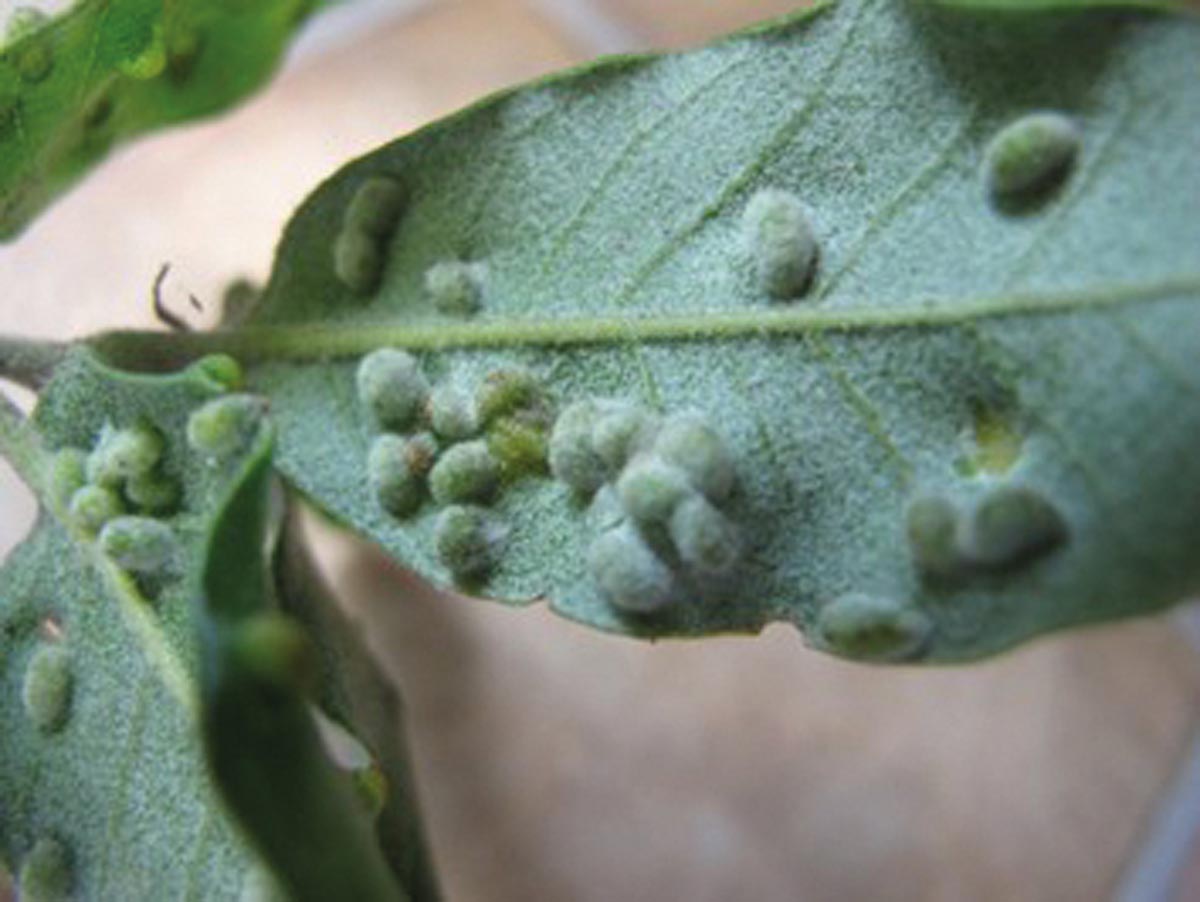
Over the winter months at DERC, most of our work is on data collected during the previous season. Some data is from our own surveys and Bryan and Fiona’s reports below cover some of the sites visited in 2023 – but the majority of our data comes from others, and we are always interested in something new. In August 2023, we received our first record for galls on Holm Oak caused by the gall midge Dryomyia lichtensteinii. More often recorded from Spain and southern Europe, this gall appears to be spreading, with records from East Sussex and now Poole, so one to look out for this summer.

Carolyn Steele (Records Centre Manager)

© Christina Hart-Davies

Galls on Holm Oak

Biodiversity on Dorset Council Farms

There are 18 farms (covering 900ha) owned and tenanted by Dorset Council within the Dorset and Cranborne Chase National Landscapes, all of which have potential to contribute to the recovery and expansion of ecological networks across Dorset. Prior to 2021 most farms had not had any form of ecological assessment so, under guidance from Dorset Council’s Natural Environment Team (NET), this was the starting point – to identify the existing biodiversity value of the land and potential improvements to enhance biodiversity. The purpose is to help tenants make the most of future environmental grants and funding opportunities.

The ecological baseline surveys were conducted by DERC in 2022 and 2023 and for each farm or cluster of farms, we recorded the key ecological features for protection and enhancement. The survey reports also set out opportunities to restore and create habitats that would help deliver climate and ecological emergency targets for water quality, carbon sequestration, natural flood management and climate resilience driven by the emerging Local Nature Recovery Strategy.

Over 350 hedgerows were assessed of which 60% were identified as Significant Dorset Hedgerows, containing eight or more native shrubs over their length, making hedgerows an important ecological and landscape feature. Many had mature hedgerow trees – mostly Oak with some Ash and Maple. Mature trees support many other species, including several Red Listed lichens, Barn Owl and Tawny Owl nesting sites and opportunities for roosting bats. 

High quality species-rich grassland of county importance was confined to steep slopes on a few farms in the west of the county where Knapweed, Bird’s-foot-trefoil, Corky-fruited Water-dropwort and Devil’s-bit Scabious were found.  However, most farms had watercourses, another key habitat feature, often with small streams fringed by narrow areas of woodland. These act as ecological corridors allowing bats, birds and mammals in particular to move through the landscape.

The farm reports produced by DERC will be used by Dorset Council in discussion with tenants for on-the-ground delivery of habitat and species projects. With appropriate funding, these could include:

  • additional hedge/small copse planting or natural regeneration in field corners;
  • creating small wetland areas, improving water quality and contributing to natural flood management;
  • planting new standard trees in hedgerows which will become the future veteran and ancient trees of the countryside, supporting a wealth of pollinators and birds such as barn owls;
  • restoring herb-rich pastures on steeper land or in areas of rough grazing to support wildflowers, pollinators and small mammals. 


The work was funded through the Farming in Protected Landscapes (FIPL) grant scheme matched with funds from Dorset Council’s habitat compensation framework. In the past council farms have been seen as a commercial asset and a first step for new farmers but, with targeted work, they will also become important sites for biodiversity and conservation.

Nikki Taylor (Principal Ecologist, Dorset Council) and Bryan Edwards (DERC Ecologist)
© Bryan Edwards

Hedgerow trees

Parasitic Plants

Moving on from the predatory plants of the previous DERC newsletter, I wanted to focus on another interesting group – parasitic plants. These tap into the roots or more rarely, branches of their host plant, robbing nutrients, minerals and water. Not all are completely parasitic, some being able to photosynthesise, particularly as seedlings – these are the hemiparasites. 

Most of Dorset’s parasitic plants are from the Broomrape family or Orobanchaceae. One of the better-known species is Yellow Rattle (Rhinanthus minor), which is widely used in grassland creation and restoration. Through its parasitism of grasses, it reduces grass dominance within the sward, allowing other species to colonise and spread. Other species within the family include Yellow Bartsia (Parentucellia viscosa), Red Bartsia (Odonites vernus), Common Cow-wheat (Melampyrum pratense), Louseworts (Pedicularis spp.), Eyebrights (Euphrasia spp.), Toothwort (Lathraea squamaria) and the Broomrapes (Orobanche spp.) themselves.

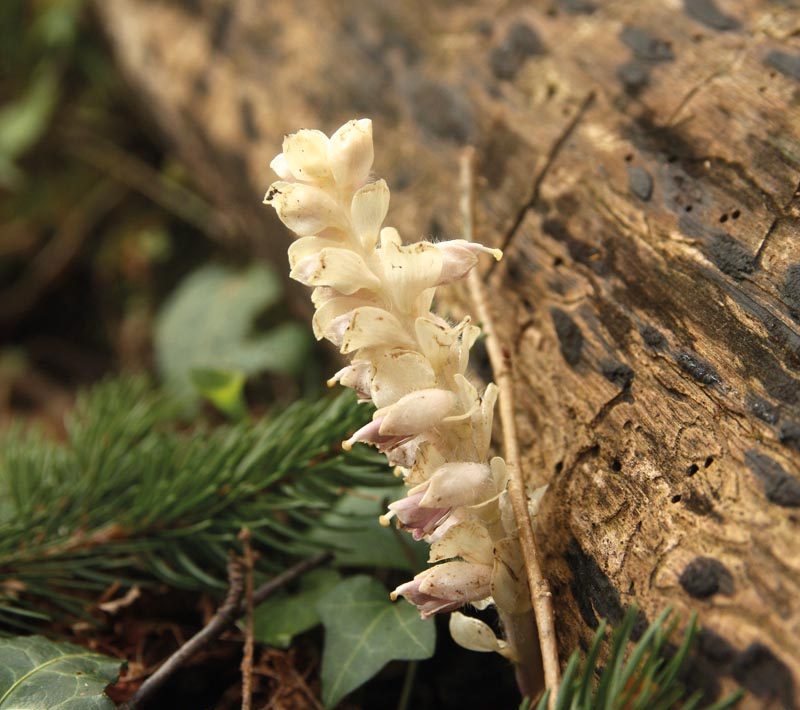
The ghost-like pink-white flower spikes of Toothwort emerge in the spring from the woodland floor, often flowering before many of the other woodland plants. This ancient woodland indicator and Dorset Notable Species has no chlorophyll and is entirely reliant on the nutrients it steals from its host plant’s roots. Hazel, Ash, Elm and Alder are thought to be the main host plants. I pay a visit every year to my local colony of Toothwort where there are over fifty flower spikes below Poplar, Pine and Holly trees (they haven’t read the books). For me, their presence is a welcome sign that spring has arrived and summer is on the way.

I have encountered Ivy Broomrape (Orobanche hederae) on Portland whilst surveying grassland and was pleased to spot the plant growing against a fence on my local high street. As is indicated by the name, this plant mainly parasitises Ivy. It is no way near as common as its host and in Dorset it tends to be found near the coast. This one is also a Dorset Notable Species.

© Fiona Wood

Toothwort

On one of my heathland surveys, I re-found a plant of Greater Broomrape (Orobanche rapum-genistae), listed on the Dorset Rare Plants Register (DRPR) and Vulnerable on the England Red List, which parasitises Gorse or Broom. Records for this species are few and far between, although it can have flowering spikes of up to 1m in height.

Outside of the Orobanchaceae are the parasitic plants of Dodder (Cuscuta epithymum) and Mistletoe (Viscum album). Dodder, of the Morning Glory family or Convolvulaceae, is also on the Dorset Rare Plant Register. It is red pigmented with tiny pink flowers and can sprawl across its host plant like a tangle of fishing wire or electric cables that invariably become knotted together no matter how hard you try to stop them. Dodder most commonly parasitises Gorse, Heather and Wild Thyme. Within Dorset, the plant is more frequently found in the east of the county and I discovered a stronghold for the species at Holt Heath, but have also come across it in the west at Lambert’s Castle and on Chesil Beach.

Fiona Wood (DERC Habitat Surveyor)

Edited by Carolyn Steele

Registered in England as Dorset
Environmental Records Centre
Trust Company Limited

Registered Charity No. 900287
Registered Company No. 02447393

Dorset History Centre, Bridport Road,
Dorchester, Dorset DT1 1RP

Telephone: (01305) 225081
Email: derc@dorsetcouncil.gov.uk
Website: www.derc.org.uk

Explore

News

Our Community

Young Conservationists

Species of the Month

Hogchester and the Harvester

The Beauty of Weeds

Rewilding the Skies over Wild Woodbury

Taking Action for Dorset’s Rivers and Wetlands

A Haven for Wildlife at Sculpture by The Lakes

Learn the Wild Way at Kingcombe

For the Love of Wildlife

Powerstock Common Wildlife Walk

Taking a Closer Look at Micro-moths

Celebrate and Commemorate

Remembering Someone Special with a Gift for Wildlife

Book Recommendation

Save our Wild Seas

Stand up for Nature

The Fascinating Lives of Oil Beetles

Dorset Environmental Records Centre

Wild Woodbury Rewilding Diary