With generous support from the Farming in Protected Landscapes (FiPL) scheme, Dorset Wildlife Trust has partnered with species-rich Hogchester to harvest and spread wildflower seed across West Dorset. Conservation Officer, Nick Gray tells the story.
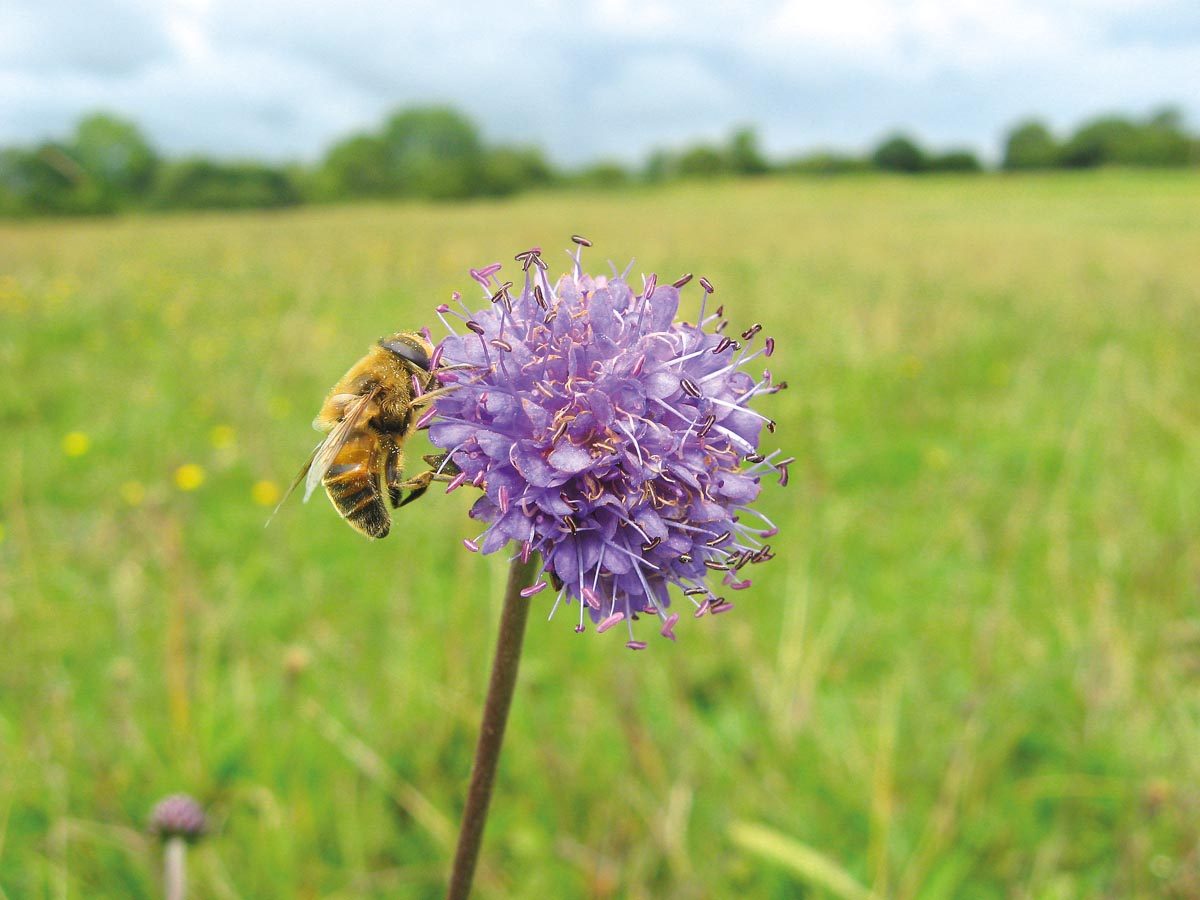
Imagine making your way across a square kilometre of wildflower meadow. All around you are the vibrant flower heads of common knapweed, cat’s-ear, oxeye daisy and West Dorset favourite corky-fruited water dropwort. Feasting on their sweet nectar are meadow brown butterflies, marbled whites and skippers, hoverflies, bumble, and solitary bees whose wider populations support so much more of our biodiversity and food crops. Legging it round the flowers’ basal leaves are small mammals whose burrowing behaviour conditions the soil and who are watched over, of course, by charismatic predators like the kestrel and barn owl. You can sense diversity at every turn and feel in your bones how essential such species-rich habitat is to our ecosystem as a whole.
Feasting on their sweet nectar are meadow brown butterflies, marbled whites and skippers, hoverflies, bumble, and solitary bees …
And why a square kilometre? Well, remarkably, this is the area of flower-rich grasslands that Dorset Wildlife Trust have restored in West Dorset over the last few years, to sustain, sequester and stun in equal measure. Even better, it’s not all in one place but scattered across the region, thereby buffering and connecting existing wildlife sites and colouring the land management mosaic, balancing food production and wildlife habitat and providing ark sites for our distinctive local flora.
A bountiful boost to this endeavour in recent times has been the inspiring partnership forged with Hogchester, near Charmouth. Having requested our assistance with wildflower meadow restoration when he arrived at Hogchester in 2016, landowner Rob Powell quickly embraced the diversity of his burgeoning meadows and set about celebrating the abundant seed produced by all the new flowers on his farm. Echoing the original Dorset Wildlife Trust Living Landscapes ‘Pastures New’ project, which flew the flag for local provenance meadow-making, our partnership set out to use Hogchester as a flower seed donor site, providing the raw materials to create new species-rich fields and patches all over West Dorset. Additionally, through all Dorset Wildlife Trust’s wider countryside landowner liaison and Sites of Nature Conservation Interest (SNCI) work, we were aware of many other donor sites, with welcoming owners. Our list of prospective receptor sites for all this seed quickly outgrew the limits of hand harvesting.
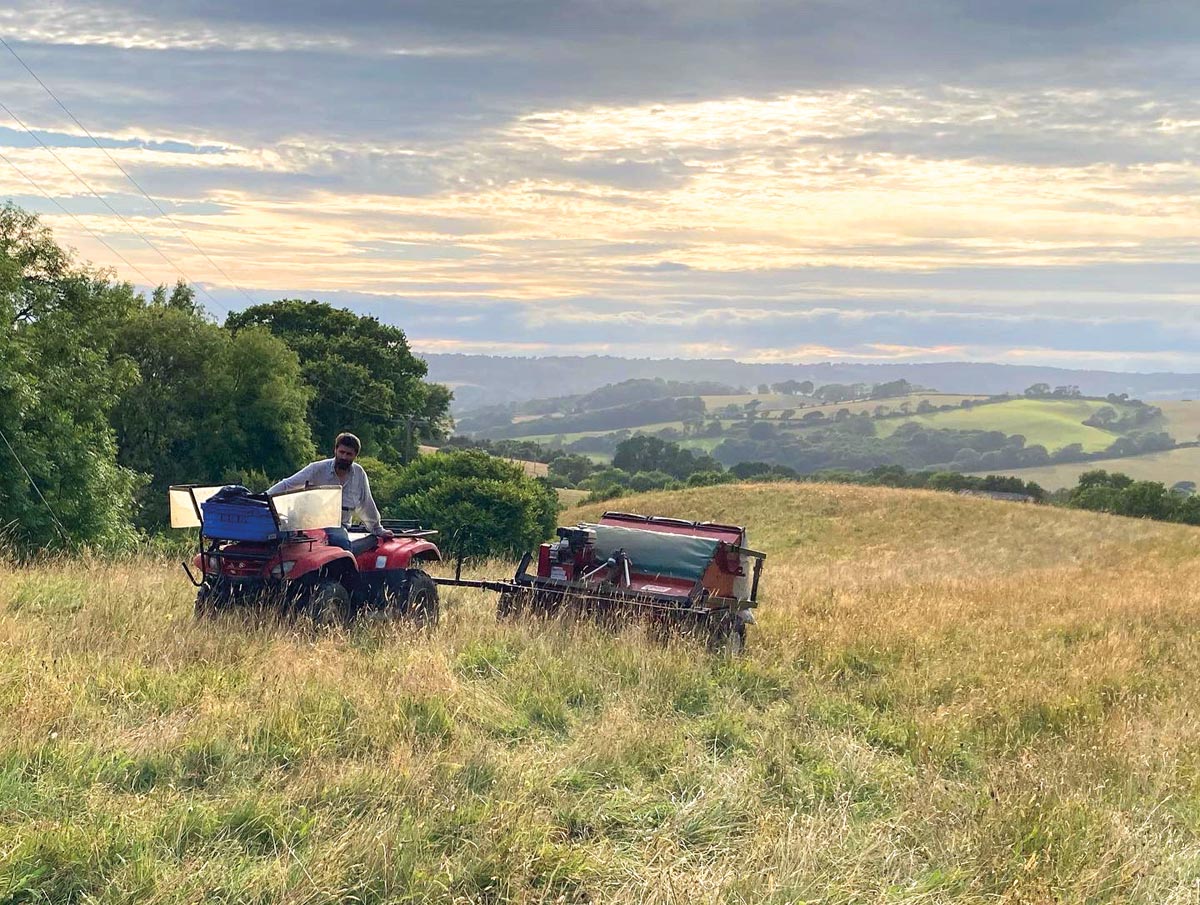
Along came the ever-enthusiastic FiPL team from Dorset National Landscape, (formerly Dorset AONB) who were very supportive from the first mention of a brush harvester and agreed to fund the machine. A nimble piece of kit, self-propelled so it can be towed behind all sorts of vehicles, the brush harvester enabled us to collect substantial quantities of seed and offer it to delighted recipients. Even last summer, we somehow managed to harvest 200 kg of seed between all the downpours. And after some painstaking winnowing and processing (FiPL also funded some of our time), the seed was strewn on 20 hectares of suitable ground in years one and two, at 34 different sites. Much deserved despair comes from the oft-quoted figure of 97% decline in wildflower meadows since World War II, but Dorset Wildlife Trust and Hogchester are stemming the tide in West Dorset with our favourite new toy and a lot of connections.
Famously, Rob’s eco-enthusiasm led to none other than David Attenborough presenting the first Wild Isles grasslands episode piece-to-camera in the middle of one of our restored meadows at Hogchester! True to this heart-lifting habitat, the images brimmed with vitality setting the scene for an episode full of enthralling wildlife and scintillating stories. In Attenborough’s words, ‘Almost all grasslands in our Isles are managed by and for people – whether in the future we choose to make room in them for wildlife is up to us.’ As we work with the many farmers and landowners in our wider countryside eager to make such room for wildlife, may the Hogchester wildflower seeds, touched by Sir David’s fair hand, and their brush harvested companions from other local donor sites be spread liberally to make many more glorious grasslands, home to hawk, hare and hoverfly.
We would like to extend our faithful thanks to the Dorset National Landscape FiPL team for their crucial funding and hearty support. We are also grateful to Gerard Russell from Heritage Seeds in Osmington who was generous with his advice and guidance on how to make best use of our machine.